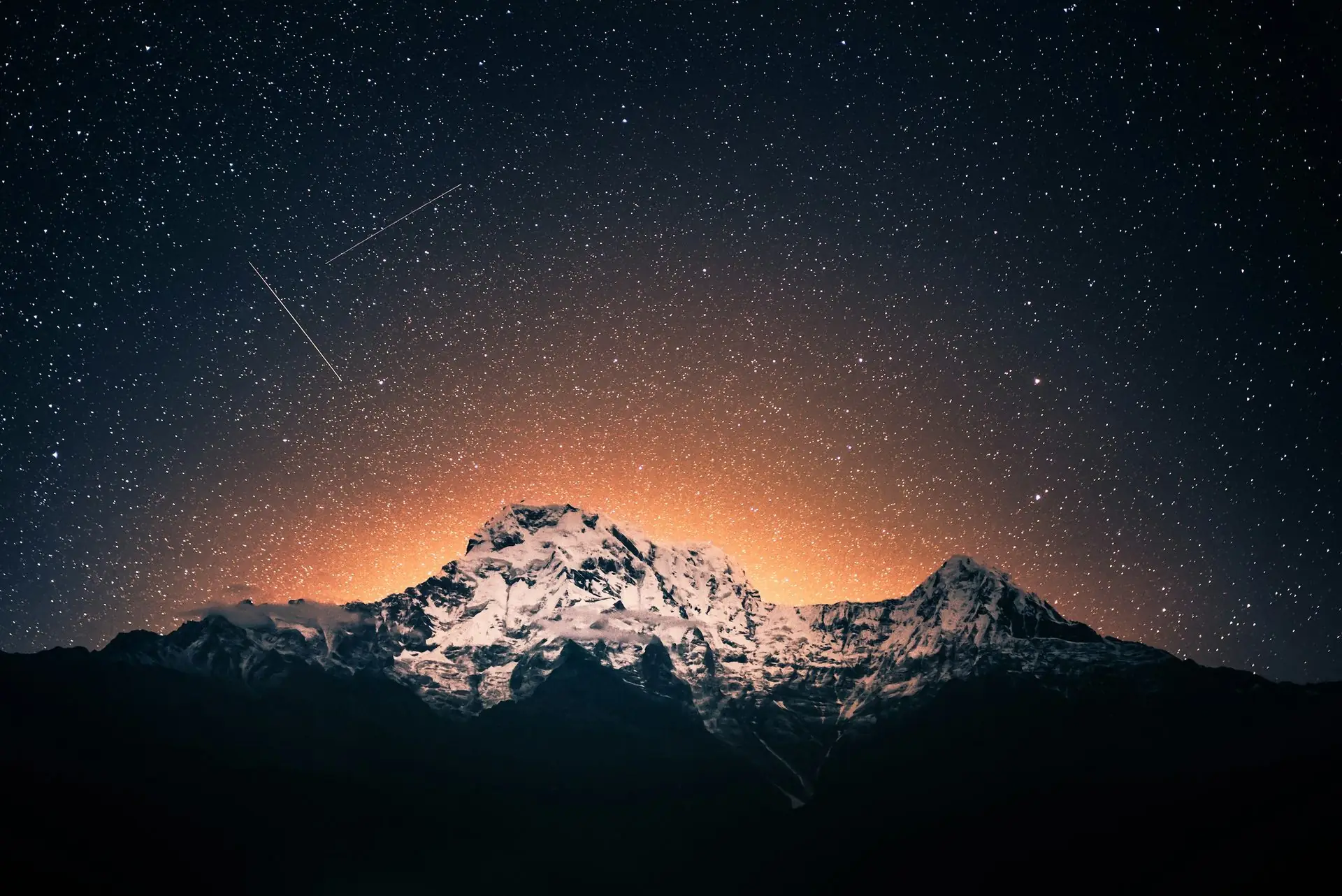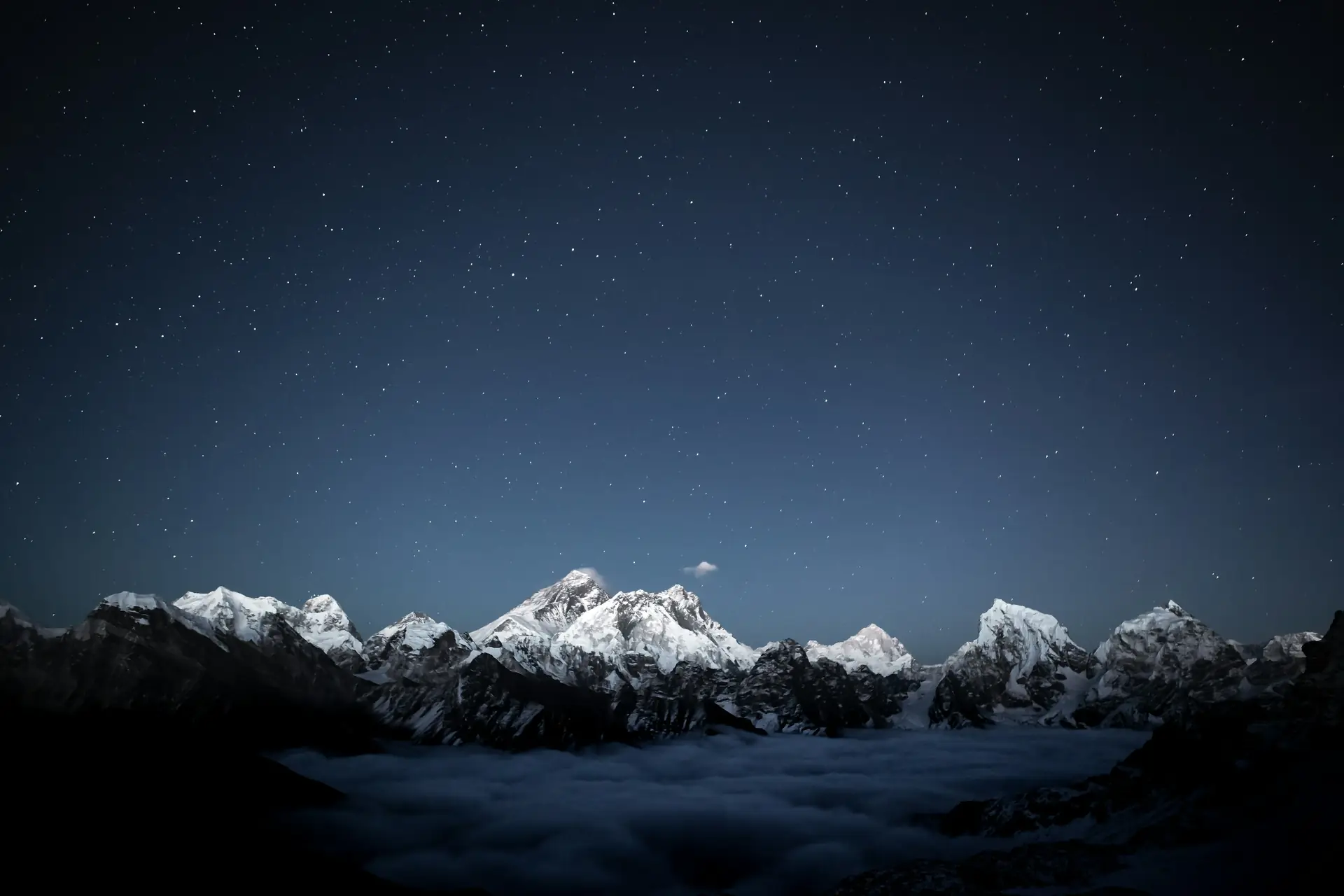







The alarm goes off at 2am, and the only sound inside the tent is the zip of a down jacket. Outside, the stars look close enough to touch, and the snow squeaks under your boots as your guide ropes the team together. A guest from Leeds, who had never worn crampons before that week, stood at the edge of the glacier and asked quietly whether he was really about to walk up a 6,000m mountain. Six hours later he was on top of it, shaking his guide's hand and looking at five of the world's highest peaks at once. That is what the best peaks to climb in Nepal for beginners offer: a real summit, a real glacier and a real sunrise, without the skills of an alpinist.
This guide covers 14 peaks. Six are classic beginner climbs, three are less common options that stay quiet, five are walk-up summits that need no climbing permit, and a short section covers peaks that look easy but are not. For each one you will find the route, the summit day, the technical level, the altitude risks, the season, the permits and the cost.
Key facts at a glance. Nepal has around 33 trekking peaks managed by the Nepal Mountaineering Association (NMA). The easiest are Pokalde Peak (5,806m), Yala Peak (about 5,500m) and Paldor Peak (5,896m). The most popular first big peak is Mera Peak (6,461m main summit). The classic step up to a real ice climb is Island Peak (6,189m). A beginner needs fitness, trekking experience, a registered agency and a licensed guide, but not climbing experience.
What Is a Trekking Peak in Nepal?
A trekking peak in Nepal is a mountain, usually between 5,500m and 6,500m, that the NMA lists as open to climbers without the full expedition permit and royalty that Everest and the other 8,000m peaks require. You still need an NMA climbing permit, a registered agency and a guide, but you do not need an expedition team or months of preparation.
The word trekking is misleading. These are real mountains with snow, ice, crevasses and thin air. On a trek you walk a trail and sleep in a teahouse. On a peak climb you leave the trail, sleep in a tent at base camp and high camp, wear crampons on snow, and start the summit push in the dark. The effort is higher, the altitude is greater and the margin for error is smaller. In return you get views no trail can match.
Nepal also has a second class of summit that beginners often overlook: walk-up peaks such as Kala Patthar and Gokyo Ri. They are summits you reach on foot, with no ropes, no crampons and no NMA permit. We cover five of them below, because for many travellers they are the right first peak.
What Makes a Peak Suitable for Beginners?
A peak suits a beginner when five things line up. The climbing is non-technical or only lightly technical, meaning snow walking, short fixed-rope sections and rope-team travel that you can learn in a day. The approach builds altitude gradually, so your body adapts over days or weeks. The summit day is long but manageable, usually six to ten hours. The mountain is forgiving, with wide slopes and a straightforward descent. And the support is in place, with a good guide-to-client ratio, proper equipment and a team that has climbed the peak many times.
A peak that fails any of these tests belongs further down the list, however good its reputation. Altitude, not skill, stops most beginners, so the approach matters as much as the summit.
Feature Table: Best Beginner Peaks in Nepal at a Glance
Peak | Type | Region | Summit height | Typical days | Technical level | Summit day | Best seasons | Permit | Crowd level |
| Pokalde Peak | Climbing peak | Khumbu | 5,806m | 14 to 17 days | Easy, snow and scree | 5 to 7 hours | Apr to May, Oct to Nov | NMA permit | Low |
| Yala Peak | Climbing peak | Langtang | About 5,500m | 11 to 13 days | Easy to moderate, snow slopes | 7 to 9 hours | Mar to May, Oct to Nov | NMA permit | Low |
| Paldor Peak | Climbing peak | Ganesh Himal | 5,896m | 14 to 16 days | Moderate, snow and short ice | 8 to 9 hours | Mar to May, Oct to Nov | NMA permit | Very low |
| Pisang Peak | Climbing peak | Annapurna, Manang | 6,091m | 15 to 18 days | Moderate, steeper summit ridge | 8 to 10 hours | Mar to May, Oct to Nov | NMA permit | Low |
| Mera Peak | Climbing peak | Hinku Valley, Khumbu | 6,461m main summit | 16 to 19 days | Non-technical glacier walk | 8 to 10 hours | Apr to May, Oct to Nov | NMA permit | Moderate |
| Island Peak | Climbing peak | Khumbu | 6,189m | 14 to 20 days | Moderate, fixed-rope headwall | 9 to 12 hours | Apr to May, Oct to Nov | NMA permit | Moderate to high |
| Naya Kanga | Climbing peak | Langtang | 5,844m | 12 to 14 days | Moderate, steeper final section | 7 to 9 hours | Mar to May, Oct to Nov | NMA permit | Very low |
| Dhampus Peak | Climbing peak | Dhaulagiri, Mustang | 6,012m | 18 to 21 days | Moderate, long high-altitude route | 7 to 9 hours | Apr to May, Oct to Nov | NMA permit | Very low |
| Ramdung Go | Climbing peak | Rolwaling | 5,930m | 16 to 19 days | Moderate, snow slopes | 7 to 9 hours | Apr to May, Oct to Nov | NMA permit | Very low |
| Kala Patthar | Walk-up peak | Khumbu | 5,545m | 12 to 14 days with EBC | Easy, trail walking | 2 to 3 hours | Mar to May, Oct to Nov | No climbing permit | High |
| Chhukung Ri | Walk-up peak | Khumbu | 5,546m | 12 to 14 days | Easy, steep trail and scree | 3 to 4 hours | Mar to May, Oct to Nov | No climbing permit | Low |
| Gokyo Ri | Walk-up peak | Khumbu | 5,357m | 11 to 13 days | Easy, steep trail | 2 to 3 hours | Mar to May, Oct to Nov | No climbing permit | Moderate |
| Tserko Ri | Walk-up peak | Langtang | 4,984m | 7 to 10 days | Easy, trail walking | 3 to 4 hours | Mar to May, Oct to Nov | No climbing permit | Low |
| Poon Hill | Walk-up peak | Annapurna | 3,210m | 4 to 7 days | Easy, stone steps | 45 to 60 minutes | Mar to May, Oct to Nov | No climbing permit | High |
Heights and times are approximate, and we confirm the details for your itinerary when you book.
The Best Peaks to Climb in Nepal for Beginners, Peak by Peak
Pokalde Peak (5,806m)
Pokalde Peak is the gentlest of the Khumbu trekking peaks, a snow-and-scree summit near Dingboche that works well as a first climb on an Everest Base Camp trip. It is also known as Dolma Khang, and it is the peak most often used as a training climb before Island Peak or Mera Peak.
The route starts as a classic Everest region trek. You fly to Lukla, walk through Phakding and Namche Bazaar, rest at Namche for acclimatisation, then continue through Tengboche to Dingboche. From the Dingboche and Chhukung area you climb to Pokalde base camp, at roughly 5,000m to 5,200m, where you spend one or two nights. The acclimatisation is the same as on the Everest Base Camp trek, which is why Pokalde suits people who have never been this high.
Summit day begins before dawn. You walk up scree and snow with a head torch, and your guide fits crampons where the slope turns to snow. A few sections are steeper, but the climbing is simple and the effort is mostly breathing. From the top you see Everest, Lhotse, Ama Dablam, Makalu and the Cho Oyu massif. The summit push takes five to seven hours return, and you are usually back at camp by midday.
Technical level: easy. You need to walk in crampons, follow a rope team and use an ice axe for balance. Your guide teaches these in a short skills session.
Altitude and risk: the altitude of 5,806m is serious, and you spend several nights above 4,500m. Fitness and acclimatisation matter more than skill. Wind and cold are the main hazards on summit day.
Best season: April to May and October to November. Autumn has the clearest skies, and spring has milder days.
Permits: an NMA climbing permit, plus Sagarmatha National Park and local Khumbu entry permits. Your agency arranges them.
Cost range: private guided climbs typically run from about US2,300toUS3,300 per person, with the flight to Lukla and climbing support making up much of the cost.
Best for: first-time climbers who want a short, low-risk peak combined with Everest Base Camp.
Yala Peak (about 5,500m)
Yala Peak is a snow-slope summit above the Langtang Valley, north of Kathmandu, and it is one of the easiest and most affordable beginner peaks in Nepal. Listed heights vary between about 5,500m and 5,732m depending on the source, and your guide confirms the figure for the day.
The trek begins with a drive to Syabrubesi, which takes most of a day. You walk through bamboo and rhododendron forest to Lama Hotel, follow the Langtang river through Langtang village, and reach Kyanjin Gompa at 3,870m. Kyanjin is a good place to spend acclimatisation days, with a yak cheese factory, a small monastery and day hikes to Kyanjin Ri at 4,773m and Tserko Ri at 4,984m. These hikes build your tolerance for altitude and give you a first look at the high peaks. From Kyanjin you climb to Yala base camp near 4,500m, and some itineraries add a high camp above 5,000m.
Summit day follows moderate snow slopes with crampons and a rope team, and takes seven to nine hours return. The summit looks across the Langtang range and into Tibet. We have a separate guide to the Yala Peak climb for readers who want a day-by-day breakdown.
Technical level: easy to moderate. The slopes are not steep, and the main skills are walking on snow and rope-team travel.
Altitude and risk: the summit is lower than Mera or Island Peak, and Langtang gives a gradual approach. Altitude sickness is still possible above 4,000m. After the 2015 earthquake much of the valley was rebuilt, and lodges are now good, but they are simpler than in Khumbu.
Best season: March to May and October to November.
Permits: an NMA climbing permit, a Langtang National Park permit and a TIMS card or local entry permit.
Cost range: private guided climbs typically run from about US1,900toUS2,700 per person, lower than Khumbu peaks because there are no flights.
Best for: beginners on a tighter budget or a shorter schedule, and anyone who wants a quieter valley than Khumbu.
Paldor Peak (5,896m)
Paldor Peak is a snow and ice summit in the Ganesh Himal area north-west of Kathmandu, and it is one of the quietest beginner peaks in Nepal. Few trekkers visit, so the approach runs through Tamang villages and high pastures where a trekking party is still a talking point.
The route builds altitude through forest and farmland, then moves onto moraine and snow as you approach base camp. You spend several nights in tents, and the trek includes time for acclimatisation before the climb. The cultural side is strong, with stone houses, prayer walls and warm hospitality in the lower villages.
Summit day involves snow slopes and short sections of ice, which call for crampons, an ice axe and a rope team. The final ridge is narrower than on Yala or Pokalde, so it asks a little more of your balance, but the slopes are not steep. Expect eight to nine hours for the summit push and return. From the top you look over the Ganesh Himal range, Langtang and, on clear days, towards Tibet.
Technical level: moderate. It teaches real mountaineering skills without being dangerous, and a low number of climbers means no queues on the ropes.
Altitude and risk: the summit at 5,896m is higher than Pokalde or Yala, so acclimatisation matters. Camps are basic and cold, and you rely on your crew for food and shelter.
Best season: March to May and October to November.
Permits: an NMA climbing permit plus the relevant conservation area and local entry permits. We confirm the exact permits for your dates.
Cost range: private guided climbs typically run from about US2,400toUS3,300 per person.
Best for: climbers who want a first peak with solitude and enjoy village life as much as altitude.
Pisang Peak (6,091m)
Pisang Peak is a 6,091m summit above the village of Pisang on the Annapurna Circuit, and it is a good way to reach 6,000m for the first time. The Manang valley gives a gentle approach and some of the best acclimatisation terrain in Nepal.
You start with a drive to Besisahar and onward by jeep, then walk the early part of the Annapurna Circuit through Chame and Pisang. You rest at Manang, 3,540m, for acclimatisation, with side hikes to places such as Praken Gompa and the Ice Lake. From Pisang you climb to base camp at about 4,380m and then to a high camp at around 5,400m.
Summit day starts in the dark. The first section is a steep rock and snow scramble, followed by a ridge where fixed ropes are often used. The final slope is steeper than on Mera Peak, and you need to be comfortable with a rope and crampons on a slope of about 40 degrees. The climb takes eight to ten hours return, and the summit view across the Annapurna and Manang ranges is exceptional.
Technical level: moderate. It is a good step up from Yala or Pokalde if you want a more demanding climb without going to Island Peak.
Altitude and risk: you spend a night above 5,000m, and the final slope is steep. Falling is the main hazard, which is why we use fixed ropes and short, careful rope teams.
Best season: March to May and October to November. The circuit is busy in autumn, but the peak itself stays quiet.
Permits: an NMA climbing permit, an Annapurna Conservation Area Project permit and a TIMS card.
Cost range: private guided climbs typically run from about US2,800toUS3,700 per person.
Best for: fit beginners who want a 6,000m summit and a culturally rich approach.
Mera Peak (6,461m main summit)
Mera Peak is the most popular first big peak in Nepal and the highest trekking peak in the country. Mera North is listed at 6,476m, and the standard route reaches Mera Central at 6,461m. The climb is a non-technical walk on a glacier, with no steep ice or rock. From the top you see five of the world's six highest mountains: Everest, Lhotse, Makalu, Cho Oyu and Kanchenjunga.
The route starts with a flight to Lukla, then heads south and east into the quiet Hinku valley, away from the Everest crowds. You cross the Zatrwa La at 4,610m, drop through forest to Kothe and follow the valley up to Tangnag and Khare at 5,045m. Khare is the main acclimatisation stop, and your guide teaches crampon, rope and glacier skills there. From Khare you climb to a high camp near 5,800m.
Summit day begins at about 2am. You follow a gently rising snow slope with a steeper final section, walking roped together in teams with crampons on. It takes eight to ten hours return. Our Mera Peak climbs are led by expedition leaders with decades of experience on this mountain, which matters more than any piece of gear.
Technical level: non-technical. The challenge is altitude and endurance. Crevasses exist on the glacier, so rope teams and guides are essential.
Altitude and risk: you spend several nights above 5,000m, and the summit is a physical test even though the climbing is easy. Cold and wind on summit morning are serious, and good layering decides comfort.
Best season: April to May and October to November. Autumn has the clearest summit views, and spring has longer days.
Permits: an NMA climbing permit, Sagarmatha National Park permit and local entry permits. Some routes also cross Makalu Barun National Park, so permits depend on your itinerary.
Cost range: private guided climbs typically run from about US3,200toUS4,500 per person, reflecting the flights, the long itinerary and the high-altitude support.
Best for: fit first-timers who want the highest accessible summit in Nepal and are comfortable with a long expedition.
Island Peak (6,189m)
Island Peak, also called Imja Tse, is a 6,189m summit in the Imja valley and the classic step up from trekking to climbing. Eric Shipton's party gave it its English name in 1951, because from Dingboche it looks like an island in a sea of ice. It is moderately technical, so it suits beginners who are fit, committed and willing to learn.
The approach follows the Everest Base Camp trail to Dingboche, then turns to Chhukung at 4,730m. From Chhukung you climb to Island Peak base camp at about 5,100m. Many itineraries include a skills day on the lower slopes, where you practise crampons, ice axe and a jumar on a fixed rope. A high camp at about 5,600m is optional, and some teams push straight from base camp.
Summit day starts around midnight or 1am. You cross a glacier and then tackle the headwall, a slope of 45 degrees or more that is typically 100m to 150m long and fixed with ropes. A snow ridge leads to the summit, where you look across to Lhotse, Lhotse Shar and Makalu. The climb takes nine to twelve hours, so stamina matters as much as nerve.
Technical level: moderate, with a short technical section. It is the hardest of the six core peaks in this guide, and we recommend a previous trek or climb above 5,000m first.
Altitude and risk: fixed ropes and experienced guides take the worst out of the headwall, but falling and fatigue are the main hazards. Crevasses on the glacier approach require rope teams.
Best season: April to May and October to November. Island Peak is busy in autumn, so choose your dates carefully.
Permits: an NMA climbing permit, Sagarmatha National Park permit and local Khumbu entry permit.
Cost range: private guided climbs typically run from about US3,500toUS4,800 per person.
Best for: confident beginners who want a true ice climb and a dramatic summit.
Less Common Peaks for Beginners: Quiet Options Few Agencies Sell

Naya Kanga (5,844m)
Naya Kanga, also called Ganja La Chuli, is a 5,844m peak in the Langtang region that suits climbers who have done an easier peak and want a steeper summit than Yala. It shares the Langtang approach, so acclimatisation is gradual, and it sees far fewer climbers than any Khumbu peak.
You follow the Langtang valley to Kyanjin Gompa, then climb to a base camp in the 4,900m range before moving to a high camp. Summit day is on snow with a steeper final section, where fixed ropes are common. The effort is seven to nine hours return. From the top you look across the Langtang range and Shishapangma in Tibet.
Technical level: moderate. The climbing is steeper than Yala and closer to Pisang in style. Altitude and risk are similar to Paldor, with cold and wind the main hazards. Best season is March to May and October to November. The permit is an NMA climbing permit plus Langtang National Park. Private guided climbs typically run from about US2,200toUS3,000 per person. It suits beginners who want a second easy peak or a quiet alternative to Yala.
Dhampus Peak (6,012m)
Dhampus Peak is a 6,012m summit above the Hidden Valley in the Dhaulagiri region, sometimes grouped with neighbouring Thapa Peak. It is non-technical on the climb itself, but the route is long and high, so it suits fit beginners who want something different from Khumbu.
The trek crosses high passes, including French Pass at about 5,360m and Dhampus Pass at about 5,240m, with views of Dhaulagiri at 8,167m and Tukuche Peak. You start near Jomsom or Marpha, in the dry Kali Gandaki valley, and move through Hidden Valley to a base camp on the glacier side. Summit day is a snow walk of seven to nine hours with crampons and a rope team.
Technical level: moderate overall. The climbing is straightforward, but the long days at altitude and the high passes make it tiring. The region is very quiet, lodges are basic and some nights are in tents. Best season is April to May and October to November. The permits are an NMA climbing permit, an Annapurna Conservation Area Project permit and a TIMS card. Private guided climbs typically run from about US2,800toUS3,800 per person. It suits climbers who want solitude and enjoy long, remote trekking.
Ramdung Go (5,930m)
Ramdung Go is a 5,930m snow peak in the Rolwaling valley, a quiet region beneath Gaurishankar, and it is one of the few beginner-friendly peaks in the area. The approach is the Rolwaling trek, which already builds altitude well.
You drive from Kathmandu to the roadhead in Dolakha district, then walk through Simigaon and Dongang to Beding at about 3,700m, a Sherpa village where you rest for acclimatisation. You continue towards Na and the Tsho Rolpa lake at 4,580m, then climb to a base camp and high camp. Summit day is a snow slope of seven to nine hours return, with fixed ropes on steeper sections. The view covers Gaurishankar, the Rolwaling range and the Tibetan plateau.
Technical level: moderate. It is non-technical in places, with a few steeper snow sections. Because Rolwaling is quiet, you will see few other climbers, and lodges are simple, with camping for part of the trip. Best season is April to May and October to November. The permits are an NMA climbing permit, a Gaurishankar Conservation Area permit and a TIMS card. Private guided climbs typically run from about US2,700toUS3,700 per person. It suits fit beginners who want a quiet Himalayan valley and a real summit.
Walk-Up Peaks in Nepal: Summits Without a Climbing Permit
Walk-up peaks are summits you reach on foot, usually as a side trip from a trek. They need no NMA permit, no ropes and no crampons in normal conditions, but they are still high, and altitude sickness is a real risk. For many people they are the right first peak.
Kala Patthar (5,545m) is the classic Everest viewpoint, reached from Gorak Shep on the Everest Base Camp trek. The climb takes two to three hours, and the reward is a close view of Everest, Nuptse and Pumori, especially at sunrise or sunset. It is the most popular walk-up peak in Nepal, so expect company.
Chhukung Ri (5,546m) rises above Chhukung in the Imja valley. The climb is steep, and takes three to four hours, but the view of Lhotse, Makalu and Island Peak is excellent, and the peak is far less crowded than Kala Patthar. It is also a good acclimatisation climb before Island Peak.
Gokyo Ri (5,357m) sits above the Gokyo lakes. The climb takes two to three hours, and the summit looks over the Ngozumpa glacier and four of the world's six highest mountains: Everest, Lhotse, Makalu and Cho Oyu.
Tserko Ri (4,984m) is the high viewpoint of the Langtang valley, reached from Kyanjin Gompa in three to four hours. It is a good first high summit, with a wide view of Langtang Lirung and the surrounding peaks.
Poon Hill (3,210m) is the easiest summit on this list, a 45 to 60 minute climb up stone steps above Ghorepani in Annapurna. It is not a high peak, but it offers a famous sunrise view of Dhaulagiri and Annapurna South, and it suits first-time walkers.
Peaks That Look Easy but Are Not for a First Climb
A few names appear on beginner lists that deserve a warning. Lobuche East (6,119m) has a steep, exposed ridge with mixed rock and ice, and suits climbers with previous experience. Chulu West (6,419m) in the Annapurna region has a steep ice slope near the top and demands solid crampon and fixed-rope skills. Kyajo Ri (6,186m) is a technical rock and ice climb above Namche. Ama Dablam (6,812m) is a technical alpine peak and not a beginner climb at all.
If you are unsure, start with a walk-up peak, Pokalde, Yala or Paldor. They teach the skills you need and give you a realistic sense of how you handle altitude and cold before you commit to a bigger mountain.
How to Choose the Right First Peak
- Decide how much time you have. Yala fits in 11 to 13 days, most others need two weeks or more, and Mera, Island Peak and Dhampus need three weeks with a buffer.
- Be honest about your experience. If you have never been above 4,000m, start with a walk-up peak or Yala. If you have trekked to Everest Base Camp or Annapurna Base Camp, Mera or Pisang is realistic.
- Decide how technical you want it. Yala, Pokalde and Mera are non-technical. Paldor, Pisang, Naya Kanga and Ramdung Go ask for more rope work. Island Peak has a steep headwall.
- Check your budget. Yala and Naya Kanga are the least expensive because they avoid flights. Mera and Island Peak cost the most.
- Think about crowds. Paldor, Naya Kanga, Dhampus and Ramdung Go are very quiet. Island Peak and Mera are busier in autumn.
- Choose your season. Autumn is clearest, spring is warmer, and winter and monsoon are not suitable for most peaks.
Fitness and Training for a First Peak Climb
You do not need to be an athlete, but you do need to be fit. A peak climb adds long summit days, heavy boots and thin air to a normal trek, so your body works harder at every step. Start at least 12 weeks before departure.
In weeks one to four, build a base of steady cardio, such as running, cycling or swimming, three to four times a week for 45 to 60 minutes. Add one weekend hike of three to four hours.
In weeks five to eight, extend the weekend hike to five or six hours with 8 to 10 kilograms in your pack. Add stair climbing or hill repeats once a week, and start strength work for quadriceps, glutes, calves and core.
In weeks nine to twelve, make the long hike seven or eight hours with 10 to 12 kilograms. Walk in the boots you will wear, test your layering on cold mornings and practise sleeping badly, because summit nights are not restful. In the final week, taper and rest.
Altitude training is helpful but not essential. A few nights at 2,000m to 3,000m before departure help, and so does a previous trek above 4,000m. Mental preparation matters too. Summit days are long, cold and uncomfortable, and knowing that in advance makes it easier to keep going when your legs feel heavy.

Skills and Gear You Will Use on a Beginner Peak
You do not need to arrive as a climber. Your guide teaches the basics at base camp, usually in a short skills session. You learn how to put on crampons, walk on snow and ice with a wide stance, use an ice axe for balance and self-arrest, clip into a rope team, and ascend a fixed rope with a jumar.
For gear, you need double or plastic mountaineering boots that take crampons, a harness, a helmet, an ice axe, crampons, a jumar and carabiners. Most of this can be rented in Kathmandu or Namche. Bring a sleeping bag rated to at least minus 20 degrees Celsius, layered clothing including a down jacket, insulated gloves and spare mittens, glacier goggles with side protection and high-factor sun cream. We provide a full kit list, and your guide checks your equipment before you move to high camp.
Best Season for Beginner Peak Climbing in Nepal
Autumn, from October to November, is the most reliable season. The monsoon has cleared the air, skies are stable and days are cold but bright. It is also the busiest time, especially on Island Peak and Mera Peak.
Spring, from April to May, is the second best season. Days are warmer and longer, and the lower valleys fill with rhododendron flowers. Afternoon cloud can build, but summit mornings are usually clear. March is cold on higher peaks, and late May can bring early monsoon moisture.
Winter, from December to February, is cold and windy at altitude, and most beginner peaks are not recommended. The monsoon, from June to August, brings cloud and rain, and climbing is not advisable in most areas. A useful rule: the shoulder weeks at the start and end of each season are quieter, but carry slightly higher weather risk. We build spare days into every itinerary so you are never forced to attempt the summit in poor conditions.
Permits for Peak Climbing in Nepal
Climbing a trekking peak requires an NMA climbing permit, which must be arranged through a registered agency. The fee depends on the season and the peak, and it changes from time to time. In recent years it has ranged from roughly US70toUS250 per person, with spring costing more than autumn. We confirm the current fee when you book.
You also need the standard trekking permits for the region. In Khumbu, that means a Sagarmatha National Park permit and a local entry permit. In Langtang, it is a Langtang National Park permit. In Annapurna and Dhaulagiri, it is an Annapurna Conservation Area Project permit and a TIMS card. In Rolwaling, it is a Gaurishankar Conservation Area permit. Walk-up peaks need only the permits for the trek you are on.
Permit rules change from year to year, so we handle the paperwork for you. Allow a full working day in Kathmandu for permit collection and gear checks.
Altitude, Safety and Insurance on Peak Climbs
Altitude is the main risk on every peak in this guide. Acute mountain sickness (AMS) can affect anyone above 2,500m, regardless of age or fitness. Early signs are headache, nausea, loss of appetite, poor sleep and unusual tiredness. Tell your guide at once if you notice them. Serious signs, such as confusion, loss of balance, breathlessness at rest and a wet cough, need an immediate descent, because altitude illness can progress quickly and the only reliable treatment is to go down.
Good acclimatisation is the best defence. Our itineraries include rest days, short hikes above your sleeping altitude and a steady rate of ascent. Drink plenty of water, eat well even when your appetite fades, and avoid alcohol. Ask your doctor about preventive medication before you travel.
The other main risks are cold, wind, crevasses and falls. Rope teams, crampons, helmets and an experienced guide manage them. Never climb unroped on a glacier, and never leave the group on summit day. Your guide decides whether conditions are safe, and if the weather turns, we turn back. Reaching the top matters less than getting home.
Insurance is not optional. Your policy must cover emergency helicopter evacuation, medical expenses and trip interruption, and it must explicitly include mountaineering or peak climbing up to the height of your peak, usually 6,500m. Many standard policies stop at 4,000m or exclude crampons and ropes, so read the wording before you buy.
A licensed, experienced guide and climbing team are essential. We plan one climbing guide for every one or two climbers, depending on the peak. Our guides have at least 15 years of experience, and they carry first aid supplies, a satellite phone and emergency oxygen or a portable pressure bag for use in an emergency.
How Much Does It Cost to Climb a Beginner Peak in Nepal?
Cost depends on the peak, the length of the itinerary, flights, group size and the level of support. Yala Peak and Naya Kanga are the least expensive because they avoid flights. Mera Peak and Island Peak cost the most because they include flights to Lukla, longer itineraries, high camps and larger support teams. Walk-up peaks cost nothing extra if you are already on the trek.
As a guide, private guided climbs typically range from about US1,900toUS4,800 per person, as shown in each peak section above. The price usually covers your climbing permit, guide and porters, accommodation in lodges and tents, meals on the trek, group climbing equipment and transfers. It excludes flights to Nepal, personal gear, insurance and tips.
Our prices are not the cheapest on the market, and we say so openly. We pay our guides and porters fairly, we use well-established lodges and 4-star or 5-star hotels in Kathmandu depending on availability, we provide quality group equipment and we do not cut corners on safety. On a high mountain, that is the difference between a smooth trip and an avoidable emergency. We give you a clear, itemised quote so you can see exactly what is included.
Why Climb With Nepal Vision Treks
Nepal Vision Treks has been organising trips for 34 years and has welcomed guests from more than 80 countries. We build bespoke private itineraries, so you set the pace, the route and the group size. We do not put strangers together on fixed-date departures, so the climb is built around your fitness and your goals.
Our guides have at least 15 years of experience, and our Mera Peak and Island Peak climbs are led by expedition leaders who have been on these mountains many times. We pay guides and porters fairly and keep our footprint light, with responsible waste handling and local employment on every trip. Our office is on Dabali Marga in Thamel, and you are welcome to visit before your trip to talk through your plans over a cup of tea.

Frequently Asked Questions
What is the easiest peak to climb in Nepal?


What is the best peak for a first Himalayan climb?
Do I need climbing experience to climb a trekking peak in Nepal?
How fit do I need to be to climb Mera Peak?
Is Island Peak suitable for beginners?
Which trekking peaks in Nepal are least crowded?
What is the difference between a trekking peak and a walk-up peak?
How much does it cost to climb a peak in Nepal?
When is the best time to climb in Nepal?
Do I need a guide to climb a trekking peak in Nepal?
What insurance do I need for peak climbing in Nepal?
How long does it take to climb Mera Peak?
Ready to Climb Your First Himalayan Peak?
Tell us how many days you have, how much trekking experience you carry and what you want from the mountains, and we will suggest the right peak and build the trip around you. Email [email protected], or call or WhatsApp +977 9802342081. You can also visit our office at Dabali Marga, Thamel, Kathmandu.